Bed bug and termite product pricing spans a range — here’s where premium pricing actually buys meaningful improvement.
The budget versus premium framing is a little misleading for this category, because price tier is not the variable separating products that work from products that do not. The variables that matter are the active ingredient, whether the label covers your confirmed pest, and whether the application method suits the situation. All three cut across price tiers, and it is entirely possible to buy an expensive product that is simply wrong for your problem.
- EPA registration and pest-specific labeling matter more than price tier for bed bug products.
- Premium termite bait systems often offer better monitoring features, meaningful for DIY approaches.
- Verify EPA registration and correct pest labeling regardless of price tier.
- Premium pricing often reflects convenience features rather than fundamentally different core efficacy.
Bed Bug Products: Active Ingredient and EPA Registration Matter Most
Both budget and premium bed bug products, if EPA-registered and labeled specifically for bed bugs, use similarly regulated active ingredients — the premium price often reflects application convenience (aerosol vs. concentrate requiring mixing) rather than fundamentally different efficacy.
The one active-ingredient issue worth understanding before comparing prices is resistance. Widespread pyrethroid resistance in bed bug populations is well documented, and a large share of inexpensive consumer sprays rely on pyrethroids alone [1]. A resistant population can cross a freshly treated surface with limited effect, which is the most common explanation for a product that appeared to do nothing despite careful application. Reading the active ingredient panel is more informative than reading the price tag.
Products combining actives with different modes of action, and desiccant dusts, are the usual answers to that problem. Desiccants work mechanically by abrading the insect cuticle rather than through a biochemical pathway, so resistance does not apply in the same way. Among desiccants, silica-based dusts generally outperform diatomaceous earth in comparative testing. Dusts also need to go down as a barely visible film in cracks and voids rather than a heavy layer, because insects avoid visible piles of powder, and that application error is far more common than buying the wrong brand.
Termite Products: Coverage and Application Method Differences
Premium termite bait systems often include more sophisticated monitoring features (indicator windows, easier station access) and sometimes broader-spectrum bait formulations — meaningful differences for a DIY monitoring approach compared to basic budget stakes.
The larger distinction on the termite side is not budget versus premium but bait versus liquid barrier, and it decides whether the job is realistically a homeowner project at all. A proper liquid soil treatment involves trenching around the foundation, drilling through slabs and attached porches, and applying large volumes at label rates measured in gallons per linear foot per foot of depth. A continuous, unbroken treated zone is the entire point, and a partial application is not a partial result so much as a gap the colony will eventually find.
Bait systems suit homeowner installation far better, and they work on a different principle [2]. Rather than excluding termites, they exploit the colony’s food sharing, using slow-acting growth regulators that workers carry back and distribute. That mechanism is why baits take months rather than days, and why patience is part of using them correctly. The same transfer logic underlies modern non-repellent liquid termiticides, which termites cannot detect and therefore tunnel through rather than around, unlike older repellent formulations they simply detour.
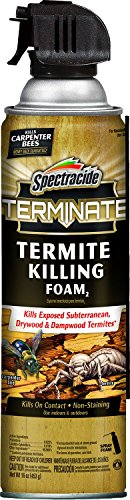
What Matters Most Regardless of Price Tier
EPA registration and a label specifically matching your target pest matter more than budget-vs-premium tier — verify this for any product regardless of price point.
Verification is worth doing directly rather than by proxy. Registration numbers appear on the product label and can be checked against the EPA’s own database, which also lists the registered use sites and pests. Retailer listings are frequently out of date, occasionally describe a different formulation than the one shipped, and are not the regulatory record. A product marketed for general household insects is not the same as one registered and labelled for bed bugs, even where the active ingredient overlaps.
The label is also legally the instruction set rather than a suggestion, and it carries the details that decide whether the product works: which surfaces it may be applied to, whether it can go on a mattress or only on the frame, required dilution, reapplication intervals, and ventilation and re-entry requirements. Most disappointing outcomes with a correctly chosen product trace back to application that deviated from the label rather than to the chemistry.

Where Paying More Does Buy Something Real
Premium pricing is not universally hollow in this category. It buys something meaningful in a few specific places. Encasements are the clearest example: the difference between a cheap zippered cover and one tested and labelled as bite-proof and escape-proof is functional rather than cosmetic, and it usually shows up in the zipper closure design and seam construction, which is precisely where cheap covers fail.
Application equipment is the second. A pump sprayer that holds consistent pressure and produces an even fan pattern delivers the label rate the product was actually tested at. Improvised equipment does not, and under-application is a silent failure because the surface still looks treated. In the same way, a bait station with a working inspection window and a cap that opens without breaking will still be getting checked three years in, while one that has to be excavated each time quietly stops being inspected.
Where the premium is least likely to be worth it is in identically formulated products differentiated on packaging convenience, aerosol versus concentrate, or bundles padded with items you have no confirmed use for. Concentrates in particular usually cost dramatically less per treated area than ready-to-use equivalents, at the cost of having to mix accurately, which a dedicated measuring container solves for a couple of dollars.
FAQ
Is a premium bed bug spray more effective than a budget one?
Not necessarily for the same EPA-registered active ingredient — the premium price often reflects application convenience rather than fundamentally different efficacy.
How do I tell if a bed bug spray relies on pyrethroids?
Read the active ingredient panel on the label rather than the front of the package. Common pyrethroid names end in -thrin, such as deltamethrin, cyfluthrin, permethrin, or bifenthrin. Products pairing one of these with a different chemical class, or products based on desiccant dusts, are less exposed to the resistance problem.
Is diatomaceous earth worth buying if it is the cheapest option?
It does work mechanically and resistance is not a factor, but silica-based desiccant dusts generally perform better in comparative testing. Either way the application matters more than the choice: a thin, barely visible film in cracks, voids, and along frame joints, never a visible layer, which insects will simply walk around.
Can I skip professional termite treatment by buying a premium DIY product?
For monitoring and early detection, homeowner-installed bait systems are a legitimate approach. For a confirmed active infestation of the structure, a full liquid barrier is not realistically a DIY job, because its value comes precisely from achieving a continuous treated zone through trenching and slab drilling with no gaps.
Always verify EPA registration and pest-specific labeling regardless of price tier — this matters more than budget-vs-premium alone.
References
- Introduction to Bed Bugs. U.S. Environmental Protection Agency
- Termites: How to Identify and Control Them. U.S. Environmental Protection Agency
These statements have not been evaluated by the Food and Drug Administration. This information is not intended to diagnose, treat, cure, or prevent any disease. Content is for informational purposes only and is not medical advice; consult a qualified healthcare provider before starting any supplement. As an Amazon Associate we earn from qualifying purchases.
